

Understanding what stops customers from getting in touch can help a business turn more interest into genuine enquiries.
Most businesses assume that a lack of enquiries means they need to reach more people. Sometimes that is true. If too few people know that the business exists, visibility will naturally be a problem.
But visibility is not always the whole story.
A potential customer may already have seen your advert, visited your website, read your reviews or looked at your social media. They may be interested in what you offer and genuinely need your help. Yet they still leave without calling, sending a message or completing your form.
That happens more often than most businesses realise.
The customer may not have rejected you. They may simply be uncertain, confused or unable to work out what to do next. A small unanswered question can be enough to delay an enquiry. Several unanswered questions can cause someone to leave altogether.
The problem is that these lost enquiries are difficult to see. You know when somebody contacts you, but you rarely know how many people considered contacting you and decided not to.
Understanding what creates that hesitation can help you remove the obstacles standing between customer interest and action.
Customers are trying to reduce uncertainty
When customers first encounter a business, they usually know much less than the business owner assumes.
You understand your services, prices, processes and industry. You know what happens when somebody contacts you and what information you need from them. You may have explained it hundreds of times.
The customer has not.
They may be wondering:
- Does this business provide exactly what I need?
- Do they cover my area?
- Will the service be within my budget?
- Can I trust them?
- Will somebody pressure me into buying?
- How quickly will they respond?
- What happens after I make contact?
- Am I ready to have this conversation?
These questions create uncertainty. Every clear answer makes it easier for the customer to continue. Every missing answer gives them another reason to hesitate.
As we explained in How Customers Decide Who to Use, customers rarely make one big decision. They make several smaller decisions as they notice, understand, assess and compare a business.
Getting in touch is one of those decisions. If the customer does not feel sufficiently confident, they may stop before reaching it.
They cannot quickly understand what you do
One of the biggest barriers is a lack of clarity.
A business owner may believe their service is obvious, but a customer looking at the website or advert may see something different. Complicated descriptions, industry terminology and vague claims can make a straightforward service feel confusing.
Expressions such as “complete solutions”, “bespoke support” or “a comprehensive range of services” may sound professional, but they do not necessarily tell the customer what the business actually does.
People should not have to investigate your business to understand whether you can help them.
A customer should be able to identify the basics quickly:
- What you provide
- Who the service is for
- What problem you solve
- Where you operate
- How they can take the next step
Clarity matters because customers are usually comparing several options. If one business makes its service easy to understand while another leaves unanswered questions, the clearer business has an immediate advantage.
This does not mean every detail needs to appear in one place. It means the most important information should be obvious, with further detail available for customers who want it.
They are not sure whether the service is suitable for them
Sometimes customers understand what a business does but cannot tell whether it is intended for someone like them.
A homeowner may wonder whether a building company takes on smaller jobs. A new business may assume an accountant only works with larger companies. A customer may worry that a premium-looking shop will be outside their budget. Someone considering private healthcare may not know whether they need a referral.
If you do not explain who you help, customers fill the gaps themselves. Their assumptions may be wrong, but they can still prevent an enquiry.
Useful content can remove this doubt by describing common situations, customer types and problems. Real examples are particularly helpful because customers can recognise themselves in them.
Instead of only saying what you offer, explain when somebody might need it and how it could help. This allows the customer to think, “That sounds like my situation.”
The business does not feel familiar enough
Customers are naturally cautious about businesses they do not recognise.
They may be interested in the service but decide to wait, conduct further research or choose a name they have encountered before. Familiarity does not guarantee that a business will be selected, but it can make contacting it feel less risky.
This is particularly important when the service involves a customer’s home, health, finances, family or a substantial amount of money.
A single advert or online appearance might introduce the business, but it may not create enough confidence for an immediate response. Customers often need to see a name several times before it feels established and familiar.
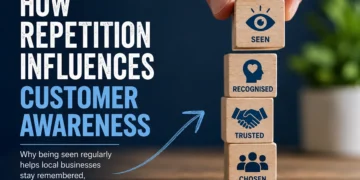
Our article about how repetition influences customer awareness explores how repeated visibility helps people move from noticing a business to recognising and remembering it.
If people visit your website but do not enquire, the answer is not necessarily to change everything. They may simply need more time and further reassurance. Consistent visibility gives them more opportunities to return when they are ready.
There is not enough evidence to trust you
Before making contact, customers look for signs that a business is credible.
They may check reviews, photographs, accreditations, case studies, testimonials or examples of previous work. They may look for a real address, a recognisable local telephone number or information about the people behind the business.
These signals help answer an important question: “Is this a genuine business that is likely to do what it promises?”
A website can look attractive but still fail to create trust. Stock images, broad claims and generic text tell the customer very little about what it is actually like to work with you.
Specific evidence is stronger.
A photograph of a completed kitchen is more meaningful than a claim about quality workmanship. A detailed customer review is more reassuring than saying you provide excellent service. A short explanation of how you solved a customer’s problem shows more expertise than simply calling yourself an expert.
Reviews are particularly important, but they should not carry the entire burden. Customers gain confidence when several parts of the business tell the same story.
The branding looks professional. The explanations are clear. The reviews are positive. The photographs appear genuine. The contact information is easy to find. Together, these small signals create a stronger sense of trust.
Customers are worried about the price
Price can prevent an enquiry even when no price has been shown.
If customers have no indication of likely cost, they may assume the service is more expensive than it really is. They may also feel uncomfortable contacting a business because they do not want an awkward sales conversation or to admit that something is outside their budget.
Publishing exact prices is not suitable for every business. A builder cannot give a reliable quotation without understanding the job, and many professional services vary according to the customer’s circumstances.
However, a complete absence of price information can still create uncertainty.
Businesses can reduce this by explaining what affects the cost, what is included, whether quotations are free and what information is needed to provide an estimate. Where appropriate, giving a starting price, typical range or example can help customers decide whether an enquiry is worthwhile.
It is also important not to assume that lowering prices will solve every hesitation. Customers consider reliability, professionalism and risk alongside cost. Our article When Lower Prices Help a Business and When They Don’t explains why the cheapest option is not automatically the most attractive.
The objective is not always to appear cheap. It is to make the value and buying process easier to understand.

Contacting you feels like too much effort
Even an interested customer can be lost if the next step is difficult.
A telephone number hidden at the bottom of a website, a form asking too many questions or a booking system that does not work properly can bring the journey to an abrupt end.
Customers have different communication preferences. Some want to call and speak to someone. Others would rather send an email, complete a short form or use WhatsApp. Offering sensible choices can make a business feel more approachable.
The main contact options should be easy to find, particularly on a mobile phone. Customers should not need to search through several pages to work out how to reach you.
Forms should only ask for information that is genuinely useful at the first stage. A long form can feel like a commitment, especially when the customer is only making an initial enquiry.
It also helps to tell people what will happen next. For example:
“Send us a few details and we will call you within one working day to discuss what you need.”
That short explanation removes uncertainty. The customer knows what information to provide, how the business will respond and when to expect contact.
The call to action is unclear
Some businesses provide plenty of information but never clearly ask the customer to do anything.
A customer reaches the end of a webpage or advert and is left wondering what the next step should be. Should they call, request a quotation, book a consultation, visit the premises or send photographs of the job?
A call to action should answer that question.
It does not need to be aggressive. In fact, a simple and specific invitation often works better than a forceful sales message.
“Call us to discuss your project” is clearer than “Find out more.”
“Request a free quotation” is clearer than “Get started.”
“Book an initial appointment” is clearer than “Contact us today.”
Different services may require different next steps. The important thing is that the customer understands what action to take and what they will receive in return.
They are afraid of being sold to
Some people avoid contacting a business because they worry that an enquiry will begin an uncomfortable sales process.
They may expect repeated calls, pressure to make a decision or an appointment with someone who will not leave until a contract has been signed. This fear is especially common when a customer is researching an expensive or unfamiliar purchase.
Businesses can reduce this concern through tone and transparency.
Explain that an initial conversation is an opportunity to understand what the customer needs. Make it clear when quotations or consultations are free and whether there is any obligation. Avoid using exaggerated urgency unless there is a genuine deadline.
Helpful content also makes a difference. When a business openly explains the options, costs, process and possible limitations of its service, it feels more like a useful adviser and less like a salesperson waiting to close a deal.
The aim is to help customers feel that they can ask a question without immediately surrendering control of the decision.
They do not know what will happen next
Uncertainty about the process can be as significant as uncertainty about the service.
Imagine somebody considering a new bathroom. They may not know whether they need measurements, drawings or a fixed budget before getting in touch. They may wonder whether the first visit is chargeable, how long a quotation takes or whether the business handles the entire project.
If none of this is explained, contacting the company can feel premature.
A simple description of the process can remove much of that hesitation:
- Contact us with a brief description of what you need.
- We arrange a convenient initial conversation or visit.
- We discuss the options and prepare a quotation.
- If you are happy to proceed, we agree the schedule.
- We keep you informed throughout the work.
The exact stages will vary, but the principle is the same. When customers can see the path ahead, taking the first step feels easier.
Your website creates doubt
A website does not need to be complicated or expensive, but it does need to feel current, secure and usable.
Broken links, missing images, outdated opening hours and pages that do not display properly on mobile devices can all reduce confidence. Even small errors may make customers wonder how carefully the business handles its actual work.
Outdated content can create another problem. If the latest news item is several years old, customers may question whether the business is still operating. If team members, services or contact details have changed, the information should be updated.
The most useful website checks are often simple:
- Can customers immediately understand what the business does?
- Does the website work properly on a phone?
- Are telephone numbers and contact options easy to find?
- Are service areas clearly stated?
- Are there recent reviews or examples?
- Does every important page provide a sensible next step?
- Is the information still accurate?
You know your own website well, so you may no longer notice its points of friction. Asking someone unfamiliar with the business to use it can reveal problems very quickly.
Give them a simple task, such as finding a particular service and requesting a quotation. Watch where they hesitate or become confused. Those moments are valuable because real customers may be experiencing the same difficulties.
Slow responses lose otherwise good enquiries
Removing barriers before contact is only half the job. What happens immediately afterwards matters just as much.
A customer may contact several businesses within a short period. The first clear and helpful response can gain an advantage, even if that business was not originally the customer’s first choice.
This does not mean every enquiry must receive a detailed answer immediately. A quick acknowledgement can reassure the customer that their message has arrived and explain when they should expect a full response.
Silence creates doubt.
The customer may wonder whether the form worked, whether the business is too busy or whether their enquiry is wanted. After waiting, they may contact somebody else.
Clear systems can help small businesses manage enquiries without needing to monitor every channel constantly. A shared inbox, simple lead record, automatic acknowledgement or regular time set aside for responses can prevent opportunities from being forgotten.
As we discuss in How Small Businesses Actually Grow Over Time, growth often comes from small improvements rather than one dramatic change. Responding more consistently, simplifying a form or making a telephone number more visible may each produce a modest improvement. Together, they can make a meaningful difference.
Customers may simply not be ready
Not every visitor who leaves without contacting you has been lost.
Some customers are researching for the future. They may be waiting for payday, planning a project, discussing the decision with their family or comparing different approaches. Others have recognised a need but are not yet ready to act.
This is normal.
Businesses sometimes react by putting more pressure on the customer, but pressure does not always solve the problem. Staying visible and helpful is often more effective.
Useful articles, regular advertising, informative emails and clear social media content give potential customers a reason to remember the business. When their circumstances change, they can return without starting their search again.
The aim is to make it easy for someone to act today while remaining memorable to those who may act later.
How to identify the barriers in your own business
You may not be able to ask people who never contacted you why they left, but you can still look for clues.
Start by reviewing the questions customers ask most often. If the same question appears repeatedly, the answer may need to be more visible before the enquiry.
Look at where enquiries come from and whether certain services receive more interest than others. Check whether customers abandon online forms or visit contact pages without completing an action. Listen to the words people use when they call. Comments such as “I wasn’t sure whether you did this” or “I couldn’t find anything about the process” highlight gaps in your communication.
It can also help to speak to recent customers. Ask what almost prevented them from contacting you, what information they struggled to find and what finally made them feel comfortable.
The answers may be surprising.
Businesses often spend time improving the parts they think customers value while overlooking a very small source of hesitation. The only way to find it is to look at the process from the customer’s point of view.
Make the next step feel smaller
A first enquiry should not feel like a major commitment.
The customer does not necessarily want to buy immediately. They may only want to ask a question, check availability or understand the likely cost. If the language suggests that contacting you begins a full sales process, they may wait.
Make the first step feel manageable.
Invite the customer to discuss what they need, request further information, arrange an initial conversation or send details for an estimate. Explain the process honestly and allow them to decide whether they want to continue.
The easier and safer that first step feels, the more likely people are to take it.
Final thoughts
When enquiries are quiet, attracting more attention may be part of the answer. But it is also worth examining what happens after somebody notices the business.
Can they understand what you do? Can they see that you are suitable for them? Do they trust you? Can they find the information they need? Is contacting you simple? Do they know what will happen afterwards?
Customers do not always leave because they prefer a competitor. Sometimes they leave because the competitor made the decision easier.
Removing friction does not require an expensive new website or a complete change of direction. It may mean improving a headline, explaining the process, adding genuine photographs, displaying reviews more clearly, simplifying a form or responding more quickly.
Small changes can remove important doubts.
Once a business understands what stops customers from getting in touch, it can make every stage of the journey clearer, easier and more reassuring.
Frequently Asked Questions
Why do customers visit a website but not make contact?
Customers may be researching for the future, comparing businesses or looking for information. They may also leave because the service, price, process or next step is unclear. A lack of trust signals and difficult contact options can also prevent enquiries.
How can a business encourage more customer enquiries?
Explain the service clearly, show who it is for, provide evidence of previous work, make contact details prominent and tell customers what will happen after they enquire. Responding promptly is equally important.
Should businesses display their prices online?
It depends on the service. Exact prices may not be practical for customised work, but businesses can still explain what affects the cost, provide typical examples or state whether quotations are free. Some guidance is often more reassuring than no information at all.
What makes customers trust a local business?
Trust develops through consistent visibility, genuine reviews, clear information, professional presentation, real examples, reliable communication and evidence that the business understands the customer’s needs.
Why are customers reluctant to complete contact forms?
The form may be too long, request information the customer does not have or fail to explain what will happen next. A short form asking only for essential details will usually feel easier to complete.