
Former Harvard physics instructor and Emmy Award–winning ABC News Science Editor Dr Michael Guillén has spent a lifetime exploring the deepest questions of existence. Once a committed atheist, he now speaks openly about a profound intellectual and spiritual transformation—one that challenges the long-assumed divide between science and faith.
“I used to believe that what we see is all there is,” Guillén said. “My motto was ‘seeing is believing.’”
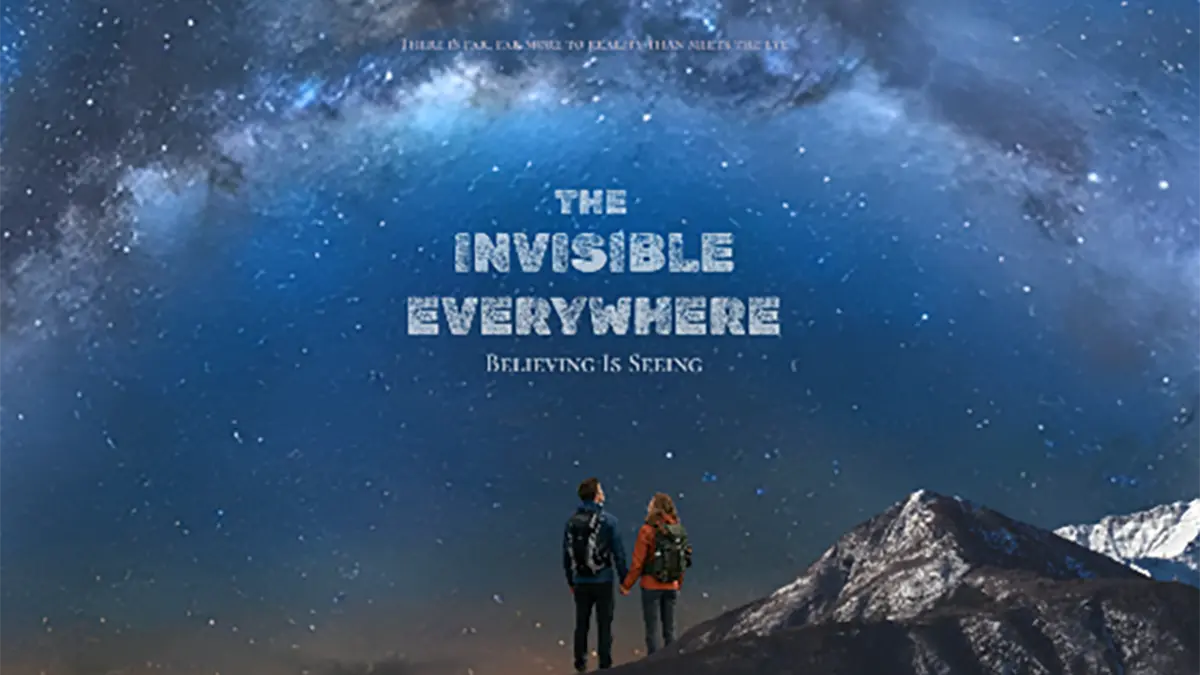
That conviction, rooted in a strictly empirical worldview, shaped his early career as a scientist. But it would not endure. Guillén’s journey from scepticism to belief is the subject of his latest feature film, The Invisible Everywhere: Believing Is Seeing, an 80-minute documentary adapted from his bestselling book Believing Is Seeing: A Physicist Explains How Science Shattered His Atheism and Revealed the Necessity of Faith.
As a young academic, Guillén embraced a pragmatic approach to knowledge. “I adopted two mottos,” he explained. “The first was ‘seeing is believing’—if I couldn’t observe it, I wouldn’t accept it. The second was that faith was inferior to logic—if you can’t prove something, I don’t want to know.”
It was during his graduate studies at Cornell University—where he earned a PhD in physics, mathematics, and astronomy—that these assumptions began to unravel.
Confronted with some of life’s most profound questions—how the universe began, the nature of consciousness, the origin of life, and the possibility of God—Guillén turned to science for answers. What he found instead were limits.

Modern physics, he notes, reveals a universe far stranger than common sense allows. From the theory of gravity to the counterintuitive world of quantum mechanics, scientific understanding rests on models that describe reality but cannot fully explain it. The discovery of cosmic expansion, confirmed by Edwin Hubble, pointed to a universe that was once vastly smaller—giving rise to what we now call the Big Bang.
Yet perhaps most striking was a realisation that challenged his foundational belief system: the vast majority of the universe is invisible.
“I learned that 95% of the observable universe is invisible,” Guillén said. “So how can I live solely by ‘seeing is believing’ if I can’t even see most of what exists?”
Equally transformative was his growing awareness of the philosophical limits of science itself. “What I learned in math is that science isn’t able to prove any of its major theories,” he said. Quoting Albert Einstein, he added: “‘No amount of experimentation can ever prove me right, but a single experiment can prove me wrong.’”
For Guillén, this marked a turning point. Science, he realised, was not the purely objective enterprise he once believed it to be. It required a form of trust—an underlying faith in the scientific method itself.
“I realised that science was not what I thought it was: it wasn’t purely logical—it required faith,” he said. “You can never really prove that the scientific method is a way of acquiring truth.”
This insight extended beyond the laboratory. Guillén argues that faith is not confined to religion but is an essential part of everyday life. “Every day you live, you exercise faith in some way,” he said. “For example, I’ve never met you before—there’s a possibility I’m talking to an AI. But I have faith that you’re intelligent and that you’ll ask good questions.”
His intellectual curiosity eventually led him beyond the boundaries of Western science. Encounters with ancient texts such as the Vedas and the I Ching opened new avenues of thought, prompting him to explore a range of philosophical and religious traditions.
“If I had to adopt any religion out of the many that I’ve explored,” Guillén said, “I would choose Christianity. The reason is that, after all these decades, Christianity aligns the most with my beloved science.”
He points to the historical relationship between Christianity and scientific advancement as evidence of this compatibility. From the founding of universities and hospitals to the contributions of clergy-scientists, the tradition has played a significant role in shaping the scientific enterprise.
The development of the Big Bang theory itself offers a compelling example. Proposed in part by Catholic priest Georges Lemaître, the theory was never seen by its originator as conflicting with religious belief. In fact, it has often been embraced by theologians as consistent with the idea of creation.
For Guillén, these convergences are not coincidental but deeply meaningful. They reflect a broader truth: that science and faith, rather than opposing one another, can offer complementary ways of understanding reality.
“If I still lived by the motto ‘seeing is believing,’ I’d be blind to most of what’s real,” he said. “Today, because of what I’ve learned on my long, winding journey, I can now see the invisible creator—everywhere. It’s a journey that changed my life forever.”
The Invisible Everywhere premiered worldwide on April 8 and is exclusively available at www.theinvisibleeverywhere.com.
“Modern science is not the enemy of God,” Guillén added. “It might very well be His strongest ally.”