
Many businesses are spending more and more of their marketing budget trying to reach younger audiences online. They chase clicks, likes, impressions, views and followers — often on platforms where attention is short, competition is fierce and loyalty can be thin.
But here is the question local businesses should be asking:
Are you overlooking the customers who already have the money, the confidence and the intention to buy?
In the UK, a huge amount of wealth sits with older households. That does not mean every person over 55 is wealthy, nor does it mean younger customers are not valuable. But it does mean that if your business sells products or services where trust, quality, reputation and local presence matter, the over-55 market should be taken seriously.
The wealth is concentrated in older households
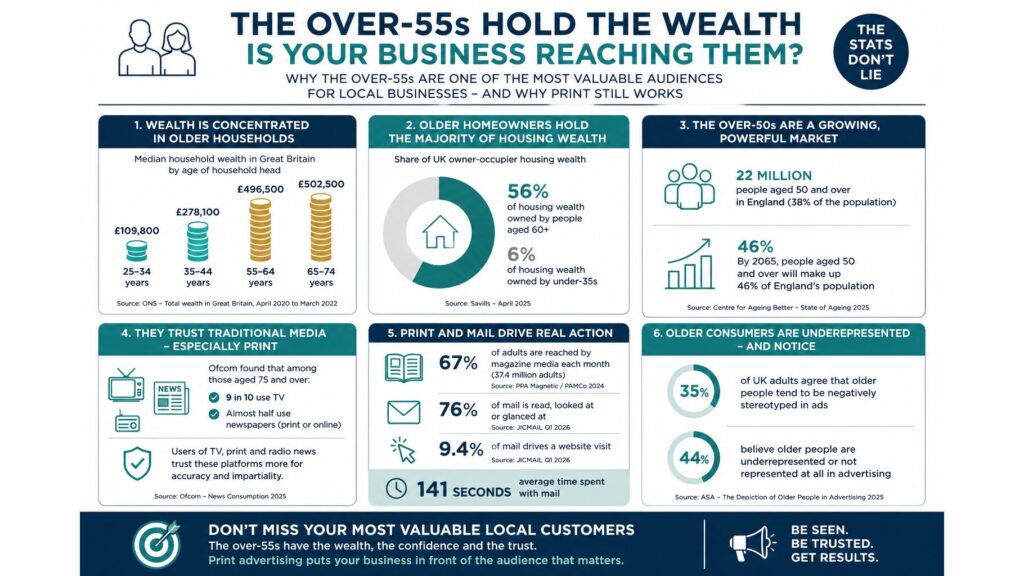
The latest Office for National Statistics wealth data shows a clear pattern: household wealth rises significantly with age. Median household wealth in Great Britain was £496,500 where the household head was aged 55 to 64, and £502,500 where the household head was aged 65 to 74. By comparison, households headed by someone aged 25 to 34 had median wealth of £109,800.
That gap matters. It shows that many older households are not just older in age — they are further along in wealth accumulation. They are more likely to have built up property equity, pensions, savings and financial confidence over decades.
The ONS also explains why wealth tends to increase with age: older households are more likely to have accumulated property wealth and private pension wealth over time. In its latest wealth bulletin, net property wealth made up 40% of household wealth and private pension wealth made up 35%.
Property tells the same story. Savills estimated in April 2025 that UK owner-occupiers aged 60-plus held £2.89 trillion of net housing wealth, controlling 56% of all owner-occupier housing wealth across the UK. By comparison, under-35s held just 6%.
For local businesses, this is not just a demographic fact. It is a commercial opportunity.
Older customers are often active, local and ready to spend
The over-55 audience should not be treated as one single group. A 56-year-old business owner, a 68-year-old retiree and a 78-year-old grandparent may have very different needs, lifestyles and spending habits.
But there are shared commercial characteristics that matter.
Many people in this age bracket are established in their homes and communities. They may be planning home improvements, booking holidays, helping family members financially, investing in wellbeing, enjoying more leisure time or choosing higher-quality products and services over cheaper alternatives.
The Centre for Ageing Better reports that there are almost 22 million people aged 50 and over in England, representing 38% of the population. It also projects that England’s older age groups will grow fastest, with people aged 50 and over expected to make up 46% of the population by 2065.
This is not a shrinking audience. It is a large, established and growing part of the market.
That matters for businesses such as home improvement companies, estate agents, legal firms, financial advisers, garden centres, restaurants, health clinics, private healthcare providers, travel companies, leisure venues, independent retailers, funeral directors, mobility specialists and premium service providers.
The mistake is assuming that “older” means passive, inactive or low-value. In reality, for many businesses, older customers are among the most valuable customers they can reach.
Your best customers may not be the ones you are chasing online
Digital marketing has its place. Search, social media, email and retargeting can all be useful. But digital advertising also comes with a problem: everyone is there.
Your advert is competing with news, messages, videos, influencers, scams, offers, memes, political arguments and dozens of other distractions. Even when an advert is seen, it may not be trusted. Even when it is clicked, it may not be remembered.
Print works differently.
A printed advert lands in a more focused environment. It gives the reader time to pause, consider and return to the message. It is not squeezed between notifications or lost in an algorithm. For local businesses in particular, print can create a sense of presence: “This company is active in my area. I recognise them. I can contact them.”
That feeling of familiarity is hard to replicate with a fleeting online ad.
Ofcom’s 2025 news-consumption research found that older people are more likely to use TV and newspapers than younger audiences. Among those aged 75 and over, Ofcom reported that nine in ten use TV, and almost half use newspapers, including print and online. Ofcom also found that users of traditional news platforms — TV, print and radio — rate them more highly for trust, accuracy and impartiality than users of online or social media news platforms.
That is the real strength of print. It is not just about reach. It is about the quality of attention and the level of trust.
Print still reaches the older audience extremely well
The idea that print is “dead” is too simplistic. Print has changed, but it still plays a meaningful role, especially among older and more established readers.
PPA Magnetic’s analysis of PAMCo data found that UK magazine media reaches 37.4 million adults each month, equal to 67% of the adult population. It also found that 17.5 million adults still read printed magazines, and that 55+ audiences remain a core audience for trusted editorial brands, with print formats over-indexing for this age group.
For a local business, that is important because print is often more than a media channel. It is a local touchpoint. A trusted publication can sit in the home, on the coffee table, in a waiting room or by the telephone. It can be revisited, shared and kept.
JICMAIL’s Q1 2026 data reinforces the point that physical marketing can drive measurable action. It reported that 76% of all mail was read, looked at or glanced at, and 9.4% of mail items prompted a website visit — a first-quarter record. Direct mail generated an average of 141 seconds of attention per item.
That is a useful reminder: print does not have to sit separately from digital. A strong print advert can drive people to your website, encourage a phone call, prompt a QR-code scan, generate a booking or bring someone into your shop.
The best campaigns often use both together.
But the message has to be right
Reaching older customers is not the same as stereotyping them.
This audience does not want to be patronised. They do not want every advert aimed at them to be about decline, frailty or end-of-life planning. Many are active, discerning, socially connected, ambitious, generous and highly engaged in their local communities.
The Advertising Standards Authority published research in 2025 showing that 35% of the UK population agreed that older people tend to be negatively stereotyped in ads, while 44% believed older people are underrepresented or not represented at all in advertising, especially in sectors such as fashion, beauty, technology and household goods.
That creates an opening for better advertisers.
The businesses that win with this audience are not necessarily the ones that shout “senior discount” the loudest. They are the ones that communicate clearly, respectfully and credibly.
A good advert for this market should focus on confidence, quality, service and trust. It should make the next step easy. It should include a clear phone number, website and location. It should avoid gimmicks. It should give people a reason to act now without making them feel pressured.
For example:
A home improvement company might focus on reliable installation, local case studies and long-term value.
A restaurant might promote a relaxed midweek dining experience, easy parking and excellent service.
A travel company might highlight expert advice, protection, comfort and carefully planned itineraries.
A legal or financial firm might lead with clarity, reassurance and local expertise.
A health or wellness provider might focus on independence, mobility, confidence and quality of life.
The common thread is trust.

The opportunity for local businesses
The over-55 market is not just large. It is commercially important.
These customers often have stronger roots in the local area, more buying confidence and a higher need for trusted recommendations. They are also more likely to respond to brands that appear established, visible and reliable.
That is where local print advertising has a distinctive advantage.
It places your business in a trusted environment. It reaches households in the area you actually serve. It gives your message physical presence. And it can work alongside your website, Google profile, social media and email marketing to create a joined-up customer journey.
The point is not that businesses should abandon digital marketing. The point is that digital alone may leave a valuable audience under-served.
If your business depends on trust, reputation and higher-value customers, then print should be part of the conversation.
So, is your business reaching them?
The data is clear: a significant share of UK wealth sits with older households. The population is ageing. Older consumers remain highly relevant to local businesses. And trusted print environments still play an important role in reaching them.
So the real question is not whether the over-55s matter.
They do.
The question is whether your business is visible in the places where they are most likely to notice, trust and remember you.