

Most customers do not remember a business the first time they see it.
That is one of the most important things for any local business to understand. A customer might see your advert, notice your van, glance at your social media post, read your name in a magazine, or hear someone mention you in conversation. But that does not mean they are ready to contact you straight away.
In many cases, they are not ready at all.
They may not need your service yet. They may not have the money available. They may be thinking about it for the future. They may be comparing options. Or they may simply be busy and distracted, like most people are.
This is where repetition becomes important.
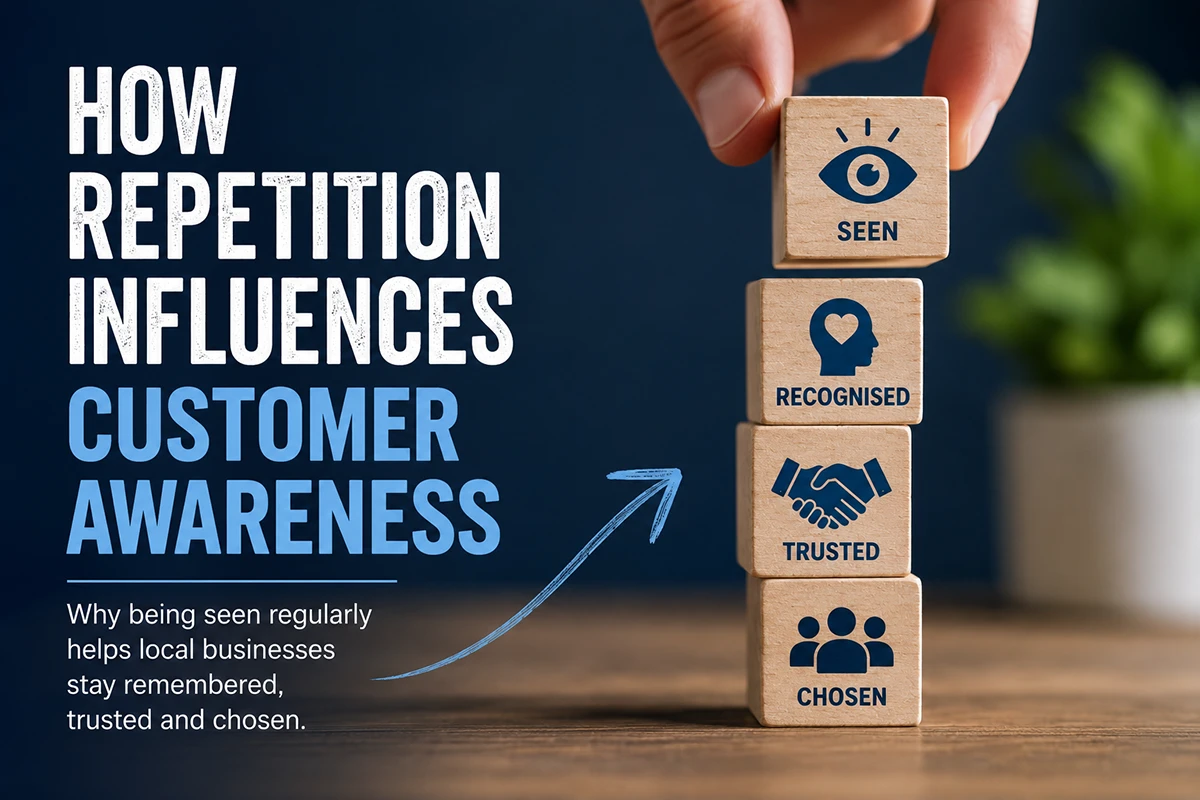
Repetition helps customers move from simply noticing your business to recognising it, remembering it, trusting it and eventually considering it when they need what you offer. It is not always instant. It is not always easy to measure. But for many small and local businesses, repeated visibility is one of the most valuable parts of marketing.
When customers see your business regularly, your name becomes more familiar. Your message becomes easier to understand. Your presence starts to feel more established. Over time, that familiarity can influence who they think of when they are ready to make a decision.
That is why marketing is rarely about one advert, one post, one leaflet, one email or one campaign. It is about being seen consistently enough that customers remember you when it matters.
Customers rarely act the first time they see a business
A common mistake in marketing is expecting too much from one appearance.
A business owner might place one advert, publish one social media post, send one email or write one blog and then quickly ask, “Did it work?” That is understandable. Every business wants to know whether its marketing is producing results.
But customer behaviour is often more complicated than that.
Most people do not go from seeing a business for the first time to making an enquiry immediately. Sometimes they do, especially if they have an urgent need. But often, the decision takes longer.
A customer may first notice your business when they do not need you. Later, they may see you again and start to recognise the name. A few weeks after that, they may hear someone mention you. Then, when the need eventually appears, your business is already familiar.
That familiarity matters because people are more likely to consider businesses they recognise.
This does not mean repetition guarantees a sale. It does not replace good service, clear pricing, strong communication or trust. But it helps create the conditions in which a customer feels more comfortable taking the next step.
If a customer is choosing between one business they have seen several times and another they have never heard of, the familiar business often has an advantage.
Awareness builds slowly
Customer awareness is not usually created in one moment. It builds over time.
The first time someone sees your business, they may only take in the name. The second time, they may notice what you do. The third time, they may realise you are local. The fourth time, they may remember you when speaking to a friend or family member. Eventually, when they need your service, your business may come to mind.
This is especially true for businesses that provide services people do not need every day.
A homeowner may only need a new driveway once or twice in their lifetime. Someone may not look for a care home until a family situation changes. A customer may not need a solicitor, accountant, estate agent, kitchen fitter, roofer, dentist, gardener or financial adviser until a specific moment arises.
But the awareness can start long before the enquiry.
This is why regular visibility matters. You are not only trying to reach people who are ready to buy today. You are also building recognition with people who may need you next month, next season or next year.
That is how many local businesses grow. Not through one dramatic marketing push, but through repeated exposure, steady visibility and trust built over time.
As we have discussed before in our article on how small businesses actually grow over time, growth is often the result of consistent activity rather than one single breakthrough. Marketing works in a similar way. Small, repeated actions can gradually build a stronger position in the customer’s mind.
Repetition helps people remember your name
For a customer to choose your business, they first need to remember that you exist.
That sounds obvious, but it is often overlooked.
Many businesses focus heavily on what they want to say, but customers are surrounded by messages every day. They see adverts, emails, signs, posts, search results, videos, leaflets and recommendations. Most of it disappears quickly from memory.
Repetition helps cut through that.
When people see your name more than once, it becomes easier for them to remember. They may not remember every detail of your advert or post, but they may remember your business name, your logo, your service or the area you cover.
That memory can be valuable later.
For example, someone may not act when they first see an advert for a local bathroom fitter. But six months later, when they start thinking about improving their home, they may remember the name because they have seen it repeatedly.
The same applies to many local businesses. Repetition gives customers more chances to absorb your message. It helps move your business from being unknown to being recognised.
And recognition is often the first step towards trust.
Familiarity reduces uncertainty
Customers do not only choose businesses based on price.
They also think about risk.
Will this business turn up?
Will they do a good job?
Will they be easy to deal with?
Can I trust them in my home?
Will they explain things clearly?
Will they still be there if something goes wrong?
These questions may not always be spoken out loud, but they sit behind many customer decisions.
Familiarity helps reduce some of that uncertainty.
When a business appears regularly, it can start to feel more established. Customers may think, “I have seen them before,” or “They seem active locally,” or “I recognise that name.” Those small thoughts can make a difference.
This is particularly important in local markets, where trust is often personal. People want to feel comfortable before they contact a business. They want signs that the business is reliable, known and easy to approach.
Repetition supports that feeling. It creates a sense of presence.
Of course, repetition alone is not enough. If the message is unclear, the service is poor or the customer experience is weak, visibility will not fix everything. But when a good business communicates clearly and shows up consistently, repetition can strengthen trust before the customer even gets in touch.
Customers are not always ready when you are marketing to them
One of the reasons repetition matters is that timing is rarely perfect.
A business may be ready to sell, but the customer may not be ready to buy.
This is completely normal.
Someone might see your advert today but not need your service for months. Another person might be interested but not have discussed it with their partner yet. Someone else may be waiting for payday, planning around school holidays, dealing with a family issue or simply putting the decision off.
If they only see you once, they may forget.
If they see you regularly, you have more chance of being remembered when the timing improves.
This is why regular marketing is often more effective than occasional marketing. You are not relying on one perfect moment. You are creating several opportunities for customers to notice you at different stages of their decision-making process.
A customer might not be ready the first time. But they may be ready the fifth time.

Repetition supports the customer journey
Customers often move through several stages before contacting a business.
They may start by becoming aware of a problem. Then they begin to understand what they need. Then they compare options. Then they look for signs of trust. Then they make contact.
This journey can be quick, but it can also take weeks or months.
Repetition helps because it allows your business to appear at different points along that journey. The customer may first see your name before they fully understand the problem. Later, they may see a message that explains your service. Later again, they may notice a testimonial, a useful article, a clear offer or a simple reminder.
Each appearance helps build the picture.
That is why the best marketing is not only about being seen. It is about being seen with a message that helps the customer move forward.
We covered this in more detail in our article on how customers decide who to use. Customers rarely make decisions based on one factor. They notice, compare, judge, question and look for reassurance. Repetition helps your business stay present during that process.
Repetition makes your message clearer
People often need to hear or see something more than once before they fully understand it.
That applies to business marketing too.
You may think your service is obvious, but customers may not. They may not understand exactly what you do, where you work, who you help or what makes you different. They may not know whether your service is suitable for them.
Repetition gives you the chance to make your message clearer over time.
One advert might focus on your main service. Another might explain the area you cover. A blog might answer common customer questions. A social media post might show a completed job. A printed feature might introduce your business in more detail.
Together, these messages help customers understand you better.
This is important because confused customers often do nothing. If they are unsure what you offer, whether you cover their area or whether you are right for them, they may not contact you.
Clear, repeated communication removes some of that doubt.
It gives customers the information they need in smaller, easier pieces.
Repetition does not mean saying the same thing badly
Some business owners worry that repetition means annoying people or repeating the same message too often.
That is not what good repetition means.
Effective repetition is not about shouting the same line again and again. It is about reinforcing your key message in different useful ways.
For example, a local business might repeatedly communicate that it is reliable, experienced and easy to contact. But it can do that through different types of content:
A clear advert
A helpful article
A customer review
A before-and-after example
A seasonal reminder
A simple explanation of the service
A local case study
A frequently asked question
A team introduction
The core message stays consistent, but the format changes.
This keeps the business visible without becoming repetitive in a negative way.
The key is to be recognisable without being boring. Customers should gradually understand who you are, what you do and why they might choose you.
Consistency is more important than intensity
Many businesses approach marketing in bursts.
They do a lot when things are quiet, then stop when they get busy. Then, when work slows down again, they restart. This is understandable because business owners are busy and marketing is often pushed aside when there is plenty of work coming in.
But this stop-start approach can create problems.
When marketing stops, awareness can fade. Customers may stop seeing your business. Competitors may become more visible. Your name may no longer feel as familiar.
Consistent marketing helps avoid that.
It does not always need to be intense. It does not mean doing everything, everywhere, all the time. But it does mean keeping a steady presence so your business remains visible.
For local businesses, this can be especially important. Your audience may be in a defined area. You do not necessarily need national reach. You need regular local recognition.
Being seen steadily in the same community can be more valuable than appearing loudly for a short time and then disappearing.
Repetition helps build trust before contact
Trust does not begin when someone picks up the phone. It often begins earlier.
A customer starts forming an opinion the first time they encounter your business. They may judge your professionalism, clarity, consistency and relevance before they ever speak to you.
Repeated visibility can support that trust.
If your business appears regularly with a clear, helpful and consistent message, customers may begin to feel more confident about you. They may see that you are active. They may feel that you are established. They may recognise your name from more than one place.
That can make the first enquiry easier.
This is important because many customers hesitate before contacting a business. They may worry about being sold to. They may not want to waste time. They may not know what to ask. They may feel uncertain about whether they are making the right choice.
The more familiar and clear your business feels, the easier it is for them to take the next step.

Repetition and local marketing
Local marketing works differently from national marketing.
A national brand may be trying to reach millions of people. A local business usually needs to be remembered by the right people in a specific area.
That changes the way we should think about marketing.
For businesses in Banbury, North Oxfordshire and the surrounding villages, local awareness is often more valuable than broad attention. It is not about being known by everyone. It is about being known by the people who are most likely to become customers.
Repetition helps build that local awareness.
When people see your business regularly in local places, local media, local searches, local conversations and local networks, it reinforces the idea that you are part of the area.
That matters because customers often like to deal with businesses that feel accessible and nearby. They may prefer someone local because they believe the service will be more personal, more accountable and easier to reach.
Regular local visibility supports that perception.
Why one advert is rarely enough
A single advert can work, especially if the timing, offer and audience are right. But it is risky to expect one advert to do everything.
One advert has to catch the right person at the right time with the right message. That can happen, but it is not the only way marketing works.
Often, the value of advertising is cumulative.
A customer may see your advert one month and not respond. They may see it again the next month and recognise it. A few months later, when their need becomes urgent, they may remember you.
This delayed response is easy to underestimate because it is not always directly trackable. A customer may not say, “I saw your advert three times and then decided to call.” They may simply say they have “seen you around” or that your name “rang a bell”.
That still matters.
Not every marketing result arrives immediately, and not every influence can be measured perfectly. Some of the most important effects of repetition happen quietly in the background.
Repetition works best with a simple message
The more often customers see you, the more important clarity becomes.
If your message is complicated, vague or inconsistent, repetition may not help much. Customers need to understand what you want them to remember.
A strong repeated message should make the basics clear:
What do you do?
Who do you help?
Where do you work?
What problem do you solve?
Why should someone trust you?
What should they do next?
This does not mean every piece of marketing has to include every detail. But over time, your marketing should build a clear picture.
For example, if you are a local service business, customers should quickly understand your main service, your area, your credibility and how to contact you.
If they cannot work that out, they may move on to someone easier to understand.
Repetition works best when it makes the right message easier to remember.
Repetition helps with word of mouth
Word of mouth is one of the strongest forms of marketing, but it is often helped by visibility.
When someone recommends a business, the customer may feel more confident if they already recognise the name. The recommendation does not arrive in isolation. It connects with something they have already seen.
For example, someone might say, “We used this company and they were really good.” If the listener has also seen that business advertised locally, the recommendation may feel stronger.
This is where repetition and reputation work together.
Marketing helps people become aware of you. Good service gives people a reason to recommend you. Repeated visibility makes those recommendations easier to remember and more likely to be acted on.
A business that is both visible and recommended has a stronger position than one relying on either alone.
Customers need reminders
People forget.
That may sound blunt, but it is true. Customers are busy, distracted and dealing with many priorities. Even if they like the sound of your business, they may not remember you later unless they are reminded.
Repetition acts as that reminder.
It keeps your business present. It brings your name back into view. It helps customers reconnect with a need they may have pushed aside.
This is why seasonal reminders can work well. A gardener may remind people before spring. A heating engineer may become more visible before winter. A tax adviser may communicate before key deadlines. A home improvement business may increase visibility when people are planning summer projects.
The reminder may not create the need, but it can bring the business to mind when the need already exists.
What repetition should achieve
Good repetition should do more than simply make a business visible.
It should help customers:
Recognise your name
Understand what you do
Remember where you operate
Feel more familiar with your business
Trust that you are active and reliable
Know how to contact you
Think of you when the need arises
If your marketing is not helping with these things, it may need to be clearer, more consistent or better targeted.
The goal is not to appear everywhere for the sake of it. The goal is to become easier to remember and easier to choose.
Final thoughts
Repetition is one of the most underestimated parts of local marketing.
Many business owners look for immediate results, and that is understandable. Enquiries, bookings and sales matter. But customer awareness often builds before any of those things happen.
People need time to notice you. They need time to recognise you. They need time to understand what you do. They need time to feel confident enough to take action.
Repetition helps with all of that.
It gives customers more chances to see your business, more chances to understand your message and more chances to remember you when they are ready.
For local businesses, this can be especially powerful. You do not need to be known everywhere. You need to be remembered by the right people in the right area.
That is why consistent visibility matters.
At Read This, we see marketing as a long-term part of building a stronger local business. One advert, post or article may have value, but the real strength often comes from showing up clearly and consistently over time.
Customers rarely make decisions in a straight line. They notice, forget, compare, ask, return and eventually act when the timing is right.
The businesses that keep showing up are often the ones they remember.